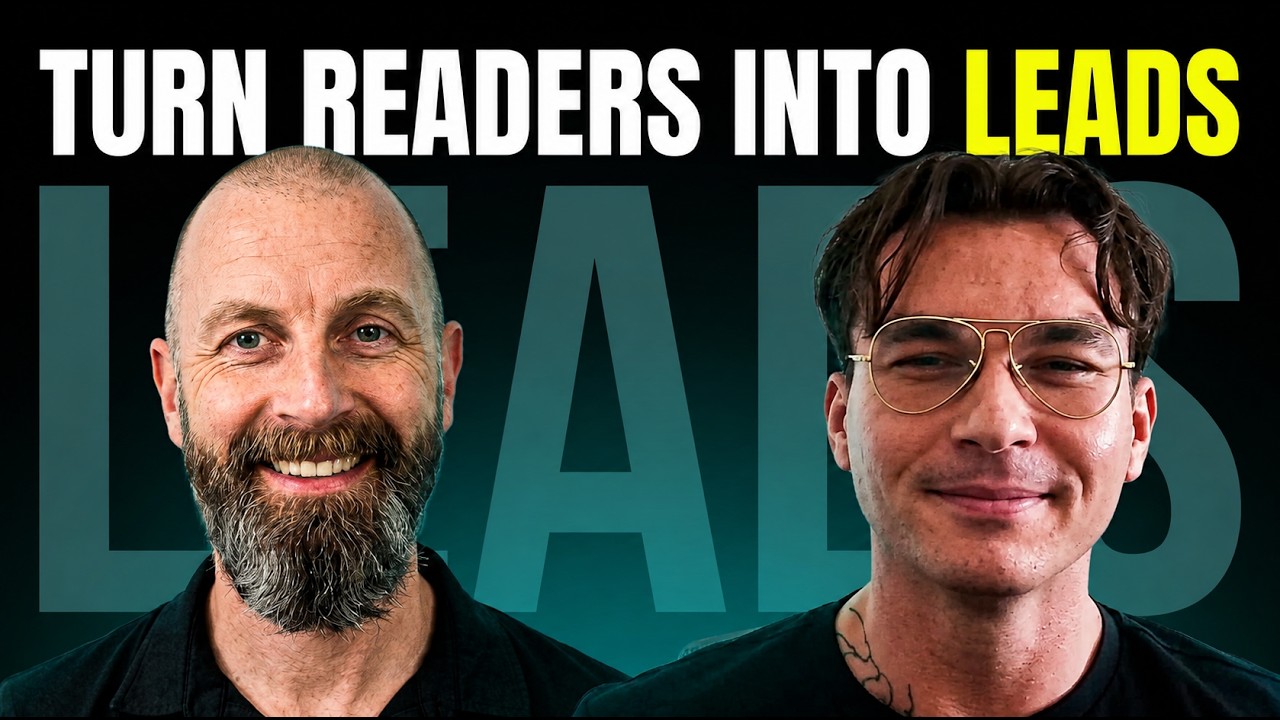
Full transcript of the conversation, published verbatim. Speaker labels come from the recording itself, not from an automated guess.
Jordan Lally:0:00
Welcome back to the High Ticket AI Systems podcast. Everyone, please welcome the winner know me, Mr. Stuart Bell. Stuart, how you doing today, my friend?
Stuart Bell:0:08
John, good to see you buddy, how you doing?
Jordan Lally:0:10
Yes sir. Fantastic. Thanks for joining us. Now, I I always ask this first question here, but essentially at a high level, what do you sell and who do you sell to?
Stuart Bell:0:22
That's what I like, straight to the business end. So I own a couple of book companies. 90 Minute Books has been around for the longest. People might recognize that name. We've been around for 15 years or so. Newer offerings in brutally honest guides and score funnels. But basically we're working with high trust businesses, businesses where your customer, your consumer needs to buy you as much as they do the product or service.
So what we do is help take your ideas and the knowledge that you've already got already and document it, package it together into a tool, an asset that kind of does that communication, does that selling, does that relationship filling for you when you're out of the room, which as I'm sure we'll get into is even more relevant these days with AI doing a lot of that relationship building work on behalf of customers. yeah, we, I trust business owners really need to. think about those opportunities to make sure that not only are they present, but they're present in the room with the prospects and with the robots. So interesting times.
Jordan Lally:1:30
No, absolutely, it definitely is. Well, I think with books, like you said earlier, it adds so much authority to the marketplace. Like saying that you're an author is just like a a a label of authority. And to to back that up further, someone that reads a full ninety minute book or a full book in general, like they are pretty bought in, hopefully, to your philosophy, your thought process, your mental mode, your mental way of thinking. And I know I didn't know this at the time.
But after just being in the industry with Alex Alex Thermozzi, the book behind me, when he first launched his book, it's it's essentially like a lead magnet. And I'm like, at the time I didn't know. I'm like, he's just giving away his value for free. But if you really think about the play that he's doing, it's like, no, dude, like I want you to read all my material, get rich as hell so I can invest into your company. Like that's that's essentially the the play behind it, which is G one might say.
Stuart Bell:2:09
Yeah.
Stuart Bell:2:25
Yeah, it's so interesting, isn't it? I mean, our whole perspective has been for, I mean, since we started, we're a marketing company primarily, books just happen to be that disproportionately effective way. It must be something to do with kind of like the, the, the trees and the day flowers that the glue's made from, must do something to people's brains. But, a thousand words on a printed page in a book is way more effective than a thousand words on a website or, or in social media.
So the fact that the book isn't the product, it's the conversation that's the product. That's the that angle that Alex and everyone else takes, unless of course the book is a product and the whole separate traditional publishing world where the book is a product and everything that's associated to that. But I think for most of us as business owners, certainly as I say, high trust business owners where we need to build that relationship with people, people need to buy us as much as they do the product or service, then books still have disproportionately outsized benefit compared with the exact same effort placed somewhere else. The trick though, and again, I haven't done 1300 or so books with 90 Minute Books, the trick that, the mechanism that makes them more received by clients also can, is the supply podcast, can screw us as business owners because when we say book, We think traditional book, because that's what everyone does, because everyone thinks that books are these traditional things. So it holds everyone up. I was just on a call before we jumped on to record today with a guy who's been in business for 20 years. He knows his stuff. If I invited him to stage in front of a hundred people, I'm sure he could talk extemporaneously for hours about the subject. If we dialed in and kind of structured a couple of slides beforehand, we can have a really meaningful presentation tailored exactly to that audience. conversation was about book and all of a sudden it's this it's almost like a college assignment like if you saw my academic record you'd kind of see why my eyes glaze over when you talk about it as well but it's this academic exercise that honestly can get scored by other people it has to be right first time I've got one submission opportunity and then that's it well that's not what we're talking about that's traditional publishing which is expensive and time consuming and has it whole kind of rigmarole around it
Stuart Bell:4:50
what we're talking about is almost like a campaign tool to talk to a group of people like those hundred people in the meeting room. We just want to give them the most useful message that compels them to come and grab us when we step off stage and say, hey, I need to know more. Book in this respect as a conversation tool is the exact same thing. So it's easy for us to get wrapped up around this thing called book that has to be all of these things that we think in terms of traditional world.
But actually the most effective thing that we can do as business owners is have the asset that starts the conversation that builds that rapport. Then when we do eventually get on the phone with someone, get on the phone with someone, I'm dating myself now, get on Zoom with someone, there is that sense of relationship that they've predisposed and preselected themselves to want to work with us because the 10,000 words that they've read are aligning perfectly with what they're already thinking. And the conversation is just accelerated from there.
Jordan Lally:5:49
I have so many questions. When you say books have a disproportionate effectiveness on the rest of market the rest of the marketing channels, like how how much, like how disproportionate.
Stuart Bell:6:01
So we have the best example, funny, so there's a guy called Paul Ross, he's written a couple of books for us, all of them super small as well, like if you saw them, you'd barely think that they were books, mean, it's the minimum effective dose of a book. So he's a podiatrist, I think that's the right term for book doctor. Again, don't judge me on...
Jordan Lally:6:21
Sure.
Stuart Bell:6:25
If I ever misspeak with benefit ears, I just blame it on an accent difference and I just pretend that I'm saying the UK words, not the US words, despite the fact that I've lived here for almost 10 years. So anyway, Paul's a podiatrist. He wrote, I think the second or third book he wrote was called My Damn Toe Hurts. So whatever condition it is that makes you toe hurt, that's what the audience he was addressing. So again, going back to what we said before, if Paul was thinking that, okay, if I'm a podiatrist, what the hell do I know about writing books? If I've got to write a traditional book, I'm not going to do it. recipient on the other end. I mean, there's probably not many podiatry patients who want to War and Peace on all of this academic podiatry stuff. So anyway, my Dan Tohert talks simply about the conditions, the symptoms you might feel, some of the things you might have tried. And ultimately, if all of that hadn't worked, you probably need to come in because we need a more meaningful intervention. So he had a patient come in, didn't know the patient, just it was on the calendar, turned up, sat in the chair. About 10 minutes into the appointment. I don't know exactly how it went, but in my mind, Paul's down there kind of knelt down in front of this person and he's kind of messing with his toes. And this person, as they're talking, all of a sudden said, my God, I've just realized you're the Paul that wrote the book. That's why I'm here. I've had this problem for like 20 years. The book was exactly, I mean, it was like you read my mind. This is exactly what I've tried. All the things you said tried and may not work. tried them, they may not work. I've spent time on orthotics and different shoes and lump of meat and burying it the garden or whatever that old wives tale is. So that telegraphing of the authority, not only did this tiny little book get this person in the door, because they hadn't even thought this was an option, they were just living with it basically. So it telegraphed the authority. And then in the moment, initial consultation that Paul was having, it immediately changed from, well, I'm here, but I'm not quite sure. mean, I've read this book, I think I know it, but Ah, you're the person, it's literally you are the person who wrote the book and you are the reason that I'm here. And that rapport balance, like the check and balance account, is, I mean, it just shoots through the roof in a way that doesn't work in other medium. So there's absolutely reason for having social media campaigns and reason for having podcasts and all of these other things. But book, for whatever reason, still telegraphs more authority. And I think it's because,
Jordan Lally:8:31
Yeah.
Stuart Bell:8:50
I it's because, because I think it's because to everyone else, they look at it as an outsider and think, oh my God, a book is like a 12 month project and you've got to lock yourself away and it costs $100,000. And yes, there are people who would happily take that money off you and charge you that much. But for us wanting to do a campaign tool, we can leverage that misperception that, it's kind of like a authority arbitrage. So the outside, Everyone assumes that the telegraphed authority is up here, but on the inside, we know that actually it's down here in terms of getting it done, but it just closes that gap to accelerate the conversation.
Jordan Lally:9:30
It's the power of association. What you're saying is is beautiful right here. If I were to hang out with nothing but billionaires for like a fucking month, everyone that saw me hang out with this crew would just associate me with being a billionaire because everybody else is, right? So if I have a book, and because everyone has a not traditional way of thinking, but a way of thinking about books, and like you just framed it, it takes hours, cost a lot of money.
Stuart Bell:9:45
Yeah.
Jordan Lally:9:59
lock myself in the dungeon and if I have a book, everyone else associates that effort, authority, time, what you just said, with me. And but if for the insider, if kind of if like you know the secret sauce, it's like, well, that's not the actual case, but I'll take all the authority you give me. Thank you. And I love that. Absolutely love that. Follow up question. Sorry. When you say high trust businesses, can you give us like one or two examples or a few if you want?
Stuart Bell:10:10
Yeah.
Stuart Bell:10:20
Yes.
Stuart Bell:10:29
Yeah, yeah. For the longest time, I say, mean, Night Minute Books has been around for 15 years. was doing marketing. My background is kind of like project management on the IT side, so corporate type work. But moving across into marketing and then into the book creation company, there wasn't, I hadn't come across a useful category of people who we work with. Like, to grow our own marketing, like picking the avatar and going forward, it was always, well, I joke now because we can say that of those 1300 books, we've literally done their A to Z of companies because we've got lots of accountants and thank God we've got a Vimbabwean outsourcer. So thank you, JW Oliver. I can now say we've got the A to Z of all of them. So what was the common term? And the common term is less about the industry, it's less about the product or the service, it's less about the transaction or the mechanism. Really the commonality is this idea of a high trust business and it's where your prospects, the people who you work with need to buy you as much as they do the service. So think about airline pilots. Airline pilots aren't book clients, but they're in a high trust environment. So when you go into the plane, most people don't turn left and ask to see the pilot's pilot's license and check the logs that they did all of the thing rights. They assume that all of that's done. They assume that the service is going to be delivered. They don't question whether the plane's going to take off. They might question whether it'll take off on time. But they don't question whether it's going to take off. Hopefully they don't question whether it's going to land again. What they're picking up on is all of the other high trust elements around this world. So I use pilots as an example because they're not book-wide. So it's a good opportunity to talk about the mechanism of high trust outside of books. So in the airline, the flight type world, it's the politeness of the crew as you walk on board, the cleanliness of the aircraft, the fact that there aren't oil patches dripping around. For some people it would be how quickly, whether you get a drink served before they take off. All of these other elements are the telegraphing of the wider experience and that the customers have to buy that experience rather than technically what's delivered. The assumption is that technically it's delivered.
Stuart Bell:12:53
So for high trust business owners where a book is the answer. So physicians, all of the financial services industries, home services like HVAC consultants or building remodelers or vets, like anything where the person assumes that you can do the job. Unless you've got like a review site where it's all like one star reviews. Okay, then you've got another problem. But assuming that everyone's got four star reviews plus.
Jordan Lally:13:07
Really?
Stuart Bell:13:22
Everyone assumes that you can do the job. So the difference is that relationship, they have to buy you, want to work with you. They don't want to give you all of their retirement savings if they don't like you. They don't want you to mess around with their toe if they don't like you. They don't want to give you money to write a book unless they've got some rapport built with you. So that's the definition of the high trust business, which is industry agnostic, solution agnostic. It's all about relationships.
Jordan Lally:13:36
Right.
Jordan Lally:13:51
Thank you for the context there. And when you are crafting this ninety minute book, can you give us a like a framework that you like to follow, like the actual content inside this book?
Stuart Bell:14:01
Yeah, yeah, absolutely. So the most important thing is that we've got this is one of the books that I use for the 90 minute book business, the book blueprint scorecard. So there's eight elements there to a conversation starting book as opposed to a traditional book. So the most important one, I'll go through a couple in order, but the most important one is choosing the single target audience because A traditional book, you're trying to sell as many copies as possible. So within the genre, you want to go wide. If instead we think of it as a campaign book, kind of like a old Google ad in the old days, choosing the demographics or the audience on the back end, then leads into the title of the book, the title of the ad. So the equivalent is the title of the book, a subtitle that amplifies it. So that's the body copy of the old ad. So now we've got the audience. that have a title, the most obvious thing that resonates with them and gets them to stop their scroll. We've got the body of the ad, the subtitle of the book that amplifies it and gets them to say, yes, I am there. Then we've got a meaningful, easy, minimum viable commitment call to action, the smallest next step that they can take. So out of the book, what's the next step? Because honestly, we're not converting anyone in the book. The book isn't doing the conversion job. The book is just to get to that first point of the conversation. So what's the minimum step that they can do next, because that leads to some beneficial constraints. Because if we just started writing, man, we'd be in a black hole of six months later and still trying to dig ourselves out. So we want these constraints of we know who we're talking to, we know what's going to stop them in the scroll, we know where we want to lead them to the next step. So therefore, the content of the book, it becomes self-evident. We just need to step stone them, give them enough compelling evidence to build on the message that we're giving enough that they take that next step. We don't need to completely sell them. We don't need to give them everything. We don't need to overwhelm them with details, which might be useful in a year, but are irrelevant today. We're not trying to justify a $20 list price on the book. And we don't need to keep writing, otherwise people feel like bait and switched into just a call fraction. What we want to do is deliver the narrowest possible book that answers the question from the target audience that we've chosen.
Stuart Bell:16:24
in a way that's robust and deep so people feel good about the content and then give them an obvious next step that's easy to take. And the book kind of comes together from that. So the words on the page are the last thing, the structure around its job of work, what it's doing, that's the most important piece. And because we know our stuff, I mean, we've been in, most of us have been in business for enough years that again, going back to the stage metaphor, if you just said, my God, Jordan, I need you to come into the meeting quick. We need to deliver a presentation for an hour. And the person just flaked out. I need you to step in. You could step in and wing it for an hour because you know it enough. That's the content of the book. The structure is the most important thing. The content for us, because we know it, kind of comes easy enough.
Jordan Lally:17:11
Right. And with this marketing campaign for the ninety minute book, are we giving it away for free or are we charging a a small dollar amount for it?
Stuart Bell:17:20
There's two approaches. So for the most part, for cold traffic. So I'll give you an example. So we were working with someone recently who they are, how would you describe what they do? I'm going to butcher this completely, but basically they help mainly female audience deal with brain fog type things, some of which comes from stress, some of it comes from menopause, but really it's that whole kind of dealing with overwhelm. So as a...
Jordan Lally:17:26
Yeah.
Stuart Bell:17:50
Psychologists might not technically be the right word, but therapists dealing in that space, there's a lot of technical angles and running an ad to say, if you're dealing with stress, come and work with me, book a free appointment. Like that conversion type material or realtors, you see it billboards all around, sell your home with me. All of that kind of very close to the conversion ad is expensive.
So it's not unusual to have five, $10 ads. mean, going into like 50 and a hundred dollar ads in some industries. For Jessica, who was the therapist person, we wrote the Brain Fog solution. And I use this example because it's so ridiculously at the other end of the spectrum. going from, I forget what the exact ad spend was, but it was somewhere around $5 for more traditional ads. Still good ads, good ads in that kind of transactional type way. ads that we were running for the book went from $5 something down to 67 cents. So like 67 cents for an opted-in ad. Now, I don't know what the numbers were. I can't remember the numbers for conversion rates overall. We probably didn't have quite robust absolute conversion. But to build that audience as an audience building tool at such a lower CPM on ad spend, because you're people further up the funnel, you're not asking them if they're ready to buy now.
You've just asked them if they've got a problem and identifying for that longer relationship, we've gone from the whole population of the world to the population who are broadly interested. And now we can nurture that relationship, starting by adding value in a way that's much more cost effective and looking for much more longer conversion cycle. I don't know how it is for you, but for us particularly, I mean, we talk to people all the time who got on our list like eight, nine years ago now. I should stop doing it because it makes me feel old. I was talking to someone probably two weeks ago now, who I remember speaking to when they first reached out, however long ago, we jumped on the call and said, hey, how are you doing? It's probably been a while. I mean, was it like last year or the year before? And as I'm talking here, I kind of quickly look, I just scroll back in the email to see when it was. And it was four years ago. It was kind of in COVID.
Jordan Lally:20:13
Right.
Stuart Bell:20:15
And that time is just gone. So again, high trust business, a lot of the time, because it's not like emergency plumbers, if you've got water pouring out of the wall, you need to do something about it now. For most high trust businesses, it doesn't have to be today. Therefore, it's probably tomorrow. So if we can, in a cost effective way, know the world, know, get more of that total addressable market exposure, and then stay in touch with people. so that rapport is building so that when today is the day for them, we're already there. Yeah, that's a much more cost-effective way of doing it.
Jordan Lally:20:53
Absolutely. I know Alex and a couple other guys have this idea as well, but it's essentially it's like a low ticket to high ticket funnel ascension pathway. We can just it very similar concept, but what you're describing is very important for the audience to understand. Like the point of the funnel is to get people in your ecosystem for as cheap and semi qualified as possible.
Through the funnel process of like you know kicking people out that aren't a good fit, or now simply isn't the right time. I just heard about you. If they're in the ecosystem, we could do something about that, right? We can nurture them, send them material, just is just point one, get them in the ecosystem. But going back to the point where you described earlier, you know, having a super bottom of funnel call to action, like, hey.
Sell your house with me, that's gonna cost a significant amount of dollars. And not everyone is ready for that. But more people are probably open to the idea of like the six steps to to prepare for when it comes to selling my house. Like a lot more people would grab that, that 90 minute book as an example of the name, opposed to calling dude, calling Jeff over here that's on the freaking billboard, right? And now that they're in the ecosystem, there's so many things that we can do with that.
Stuart Bell:22:12
Yeah.
Jordan Lally:22:15
Contact information. And like you said, I mean, proof is in the frickin' pudding. You spoke with someone four years ago, and now you're speaking with them again. And you know, like that's that's amazing.
Stuart Bell:22:25
Yeah, because today is the day that they're ready. as there's a book that I read years ago by a guy called Michael, I think it's Michael Gleeson, an Australian academic guy. And I think the book is called Wombat Selling. So in his book, he talks about check moves. And I think he trains sales teams a lot, like traditional sales teams. he was saying part of the problem is that sales teams are such high turnover and churn because a lot of the metrics are on closes.
Like how many people have you got to sign on the line that started, but that is actually out of your control as a salesperson. can't control unless you like lock the door behind them and do all those dodgy tactics. You can't control whether they convert. The only thing you can control is the number of conversion opportunities that exist. So that is in your control and it's an upstream function of how many people ultimately convert and choose that today is the day for them.
That goes back to your point on, and I skipped over the question of whether to charge for the book or not. So, or whether it's a giveaway chapters, or some people will have a link on their website to the book, but it's a link to Amazon. Like, the hell cares? Like, you don't know that link, you're not going to see it. So the whole charging thing, the only reason giving away the digital version and the whole digital version is far more effective than giving away a chapter. Because if you go to a website, You're not there to buy the book or to get the book. The book isn't the product. You want the solution that they're offering. If you go to a financial advisor site because you need a money manager and they, download a chapter of a book and then go to Amazon to buy the book. I've got a million dollar portfolio here. are you nickel and diamond me and sending me to a $16 book? Like that lead. So the one time that it may be like the free plus shipping of what Alex does and a lot of others do, the physical
Jordan Lally:24:10
Right.
Stuart Bell:24:18
cost of books, if you're physically sending them to someone, that changes the dynamic a little bit. It's expensive to send books around. So if you can recover some of the cost and bring down your acquisition costs because you're asking to get paid for sending them out, there is an argument to be made there. And the relationship is different. Like physically sending someone a book and asking them to pay for shipping, food plus shipping is a common thing. Like people understand that they are getting something off, they're receiving something.
Jordan Lally:24:47
It's tangible, exactly.
Stuart Bell:24:47
So tangible, yeah. My preferred approach is not getting involved in that at all because it's so complicated and there's so many levers to pull. The people that do it, do it well, holy cow, there's a lot to think about in that world. My preferred approach is give away your digital versions, nurturing the email sequence afterwards, get people out with the book and onto the call as much as quick as possible. In that follow-up sequence, give people additional assets, additional tools where they can keep the conversation going. They can keep their journey going until they're to actually get on the phone and then keep the physical ones for scenarios where you can address visible prospects as opposed to invisible prospects. So the invisible prospects is the podiatrist example. Paul couldn't buy a list of everyone with a bit of topane in a 20 mile radius. All he could do was advertise on social media.
If you've got toe problems, then here's a great book. They're invisible prospects. Until they raise their hand, you don't know who they are. We did another book recently with an exit planning attorney, an exit plan, not attorney, it's the exit planning people. They work with a specific, they were in Louisiana, they work with a specific type of business. They could buy or new the 200 companies that even if they got 10 % of those over the next 10 years, their business would. explode. So the physical use case there is there's a fantastic door opener to get 10 copies of the book, to mail them with a note. Hey, Dave, I've been wanting to catch up with you a little while. We actually just wrote this book about exit planning and chapter three here is perfectly suited to your business because we just did another exit valuation with a company that was very similar to yours. So I think this is going to be really useful for you, Bob. Send that and then follow up the next week.
Hey Bob, I sent you a copy of the book. I just wanted to follow up. That as a door opener, as opposed to just cold calling or trying to get past the gatekeepers, physically using the books in that way, far, far, far more efficient way than doing like the free plus shipping and just trying to manipulate the numbers on ad spend.
Jordan Lally:27:06
Yeah, I'm such a simple guy. Like I will not not that I will never try that, but it just seems really complex. And like I said, I'm a simple guy. Like just have the have a PDF. So exactly, exactly. So I'm an online business owner. Let's just h hypothetical world. have a 90-minute book. What is the strategy behind getting that in the hands of people?
Stuart Bell:27:16
Yeah, and expensive if it goes wrong. Yeah.
Jordan Lally:27:33
Do you recommend Facebook meta ads where I go through that lead funnel process? Cool. So I run meta ads, have this free book. Let's give it away for free in this example. Can you walk me through that nurture sequence? Like how the funnel might be composed, like the email sequence, how how high is the frequency, what's in the email copy, without I guess giving away the secret sauce, but like high level stuff, you know?
Stuart Bell:27:49
Yeah.
Stuart Bell:28:01
Yeah, yeah, no, definitely. And I'm more than happy to give away all of the secret sauce. And actually just seeing that point that goes with the books. Like some people will say, I don't want to give everything away because then why would people come and see me? It's literally because they can't do it themselves. Like you want the people to come and see you who don't want to do it themselves. You don't want a calendar full of half DIY people because it will drive you crazy. The other thing is I'm 50, I'm 51 now.
I was around for the dawn of the internet, like the main web revolution. I was just starting work at that period of time. So going from no websites to websites. So the idea that I don't want to give away all the secret sauce that ship sails 20 years ago and two years ago with the advent of AI, believe me that ship has sailed and sunk and now the fishies are swimming around it. There is no secret sauce anymore. What you want to concentrate on is giving as much to the person as possible that they feel compelled that, this person gets it, they're a safe pair of hands. I resonate with what they're saying. I need them to do it. Because for most of us, again, in high trust businesses, it's too complicated for people to do. They're not going to renovate their own house. They're not going to manage their own portfolio. They're not going to write their own book. They could do. And there's a cohort of people that do all of that, but they're not our clients. forget about that piece. The nurture sequence and the follow up. is this kind of, I've got this term, it's in that, is one of the elements of that blueprint book, the minimum viable commitment. It's this idea of the smallest step to get people to the next stage. depending on where you are and what your business is and what the barrier to entry is for them to actually get started, it's going to vary from a tiny commitment to a much bigger commitment. So whatever we can do to make that small pieces that allow people to raise their hand. So the first, So run a meta ad. Most of the time we're doing the lead ads. So we're not bouncing them off to a landing page. We're just doing the lead ads straight away. We'll use Zapier to connect it to the CRM. So the lead will come in and then bounce to the CRM. The CRM will deliver them the email. The email will have the copy of the book. We'll put a quick question. Here's a copy of the book briefing scorecard. Chapter seven is actually really interesting because a lot of people don't think about the idea of beneficial constraints, but really.
Stuart Bell:30:26
Less is more as far as this project goes. Have you thought about a title yet? That question at the end, what we're trying to do in all of this, these aren't checkout purchases. Very few of our clients just go to the website and buy a book. Most of them need to talk to us first. So everything that we're trying to do is trying to get to that conversation. So that first delivery is that. Now, I'm not going to read too much, but there's always nuance and variation. So with a meta lead ad, You've got the concept of a thank you page. So what do we do on the thank you page? Do we want to send people straight to the download of the book to the PDF? Because people are in the moment, they're doing it there and then. Maybe don't want to send them straight to the book because with everything that's going on with email these days, we really want them to open that email because the signals that gives to their email provider that the next 20 emails that we send them are more likely to not go to spam or the the promotions folder if they've actually engaged in it. So really, although it slows up the process a little bit, we really want them to go to click on the email when it comes in. OK, but that's constraint with the user journey because if they're enthusiastic, we want to keep that momentum going, not have them bounce off to another mechanism and try and find the email. OK, so how can we close that gap? So on the thank you page of the email, it would be great to send them to a landing page, which is a video saying, hey, great to see you here.
So this is a copy of the book that I'm just sending you. One of the most interesting chapters is chapter seven, because of this idea of beneficial constraints. So go check the email now. It's got the book. In the meantime, if you want to jump forward a little bit, we also have a school card associated with this that you can take online. I'll leave a link below. I'll also put it in the email. If you've got any questions, just give me a shout. My email address, I'll put it down below on the page here. It'll obviously also be in the email. I'm really excited to see what your book's about. That way we've... built the relationship a little bit in the thank you page in the moment, but we haven't distracted from this other mechanism, which really, unfortunately, we need now. We need them to open that email. The follow-up sequence over the next period of time, we've probably got five days or so while they're still in the moment for the hottest people, which we've got no control of. We're probably not going to push many people over the fence. It's either today or it's not today. But the hottest ones, we want to give them the opportunity to get started.
Stuart Bell:32:50
So the next five days of the initial auto responder, we want to give them more credibility, more brief, more evidence so they can see it. So the next message might be, Adrian, to follow up on the book, one of the most surprising things I actually just got off the phone with someone is this idea of a book as a campaign tool and not as a be long and all, write the one thing to serve all people. So one of the best thought technologies that you can get is this concept of one book, one audience, one campaign. Your job now is just to decide who it is that you want to work with, who your best clients, what are the questions that would motivate them to raise their hand and jump on a call? What are their pain points that you can fix for them? And that's what should be in the book. There might be another book, there might be a whole load of stuff out in the book, but that one small thing. So that auto-responder sequence is really just compelling them with kind of like the testimonial type. approach, case study type approach. You don't want to call it testimonial case study because that's our language, that's internal language. The clients don't care about that. They don't want to be presented with a case study. Who the cares about that? Well, what they do want to be presented with is, hey, I just wanted to give you an example because we were working with a guy called Paul recently who didn't think he had a book because he was a podiatrist, knew what the problems were, but couldn't present that in a way. So we worked with him to work out what the biggest pain points were for that audience structure in a way, and here was the result. So, case study testimonial evidence that people can see themselves in that solution. So the five days or so of this initial response is to get the hottest people to raise their hand. After that point, everyone is tomorrow and we've got no way of knowing what tomorrow is. So what we then want is the ongoing evergreen campaign of just every week sending out more. friendly, compelling evidence, talking about books, giving them helpful insights so that when today is the day for them, hopefully they've just received an email recently from us that kind of backs up their thought that we're the people that they want to speak to.
Jordan Lally:35:00
Side question, what are your thoughts on email on the list? How frequently, like the the long-term nurture campaign. I'm not gonna lie, I do it daily. So if you end up on the list, bro, I'm sorry. I'm just kidding, but but I I do do it daily. I try to provide value Monday through Thursday, of like, here's what I'm thinking, here's how to win, blah blah blah, free value. And then Friday, because people get paid on Fridays, well, not everyone, but typically, I send my offer.
Stuart Bell:35:12
Ha ha ha ha ha ha ha ha
Stuart Bell:35:26
Yeah.
Yeah. Yeah.
Jordan Lally:35:30
What are your thoughts on that? Or I guess different question, how often do you email the long term list?
Stuart Bell:35:36
Yeah man it's so interesting email I mean you've got other videos talking about email but it's a black hole of nonsense these days.
Jordan Lally:35:38
Yeah.
Stuart Bell:35:48
My business partner in 90 Minute Books is Dean Jackson. So Dean's got this perfect idea called a super signature, which is in an email. And I've heard lots of people take it and think that it comes from different people. But the super signature is Dean's idea originally. It's a PS message in the messages that goes out and says, is whenever you're ready, here's three ways I can help you and give people three next steps that are closer to that transaction. So it's not as immediate as here's a sales offer and just here's to buy it.
But in every useful value-driven email that goes out, there's a next step that people can take. So the body of the email is all giving, is all value-driven content. But there is that PS that people can take that next, sorry, super signature, that people can take that next step. The frequency, my old answer would have been weekly and send it to everyone. All CRM systems have got opt-outs at the bottom. We're all good people. We're not trying to...
Dump people at buying lists and dump people on there. We do an email in the right way. There's an opt out on the bottom. People can click that opt out, send it weekly. Some industries can deal with daily like the Dan Kennedy approaches. Keep going until then subscribe and then they weren't a client anyway. Ours, because of the longer nature of it, daily is probably too much for us. We're not, mean, basically what you're trying to do with email is intersect at the moment that they thought, Oh, do you know what? I've had this book project on for two years. I need to do something right now.
Jordan Lally:37:07
You're all
Stuart Bell:37:16
And then being an email pops up with a link to get started. Like that would be a magic solution. If the last email I sent them was six months ago, they got to do a lot of hunting around. Weekly for us is a good enough cadence. We don't need to go more than that. Sometimes we'll go bi-weekly or twice a week because we'll send out like an email, which is just the email, like information in the email. And then we also do a lot of podcast stuff. So we'll send out the podcast release email, which has got the and the super signature in it. So technically, guess we're probably doing twice a week. What's interesting now though, and it's not my ballpark, so I won't go too much into it, but just high level. Historically, again, at a conversation two weeks ago of someone on the list from four years ago, Google would say, if they haven't opened an email in four years, I'm not going to deliver it to them anymore. And that non-open is going to damage your open rate on the other ones. So there's a whole challenging world around now of non-engaged people. But for example, I'm a Frank Kearns list. I mean, last time I opened an email from Frank Kearns was probably a number of years ago. But I don't want to unsubscribe. I'm happy to still get them because when I magically get all of this abundance of time that will suddenly land on my lap at some point, I want to go back and catch up on all of this stuff I actually want. I just can't get it in my head. So I don't want to be unsubscribed.
But Google has probably unsubscribed me. I bet if I went to look, I've either been unsubscribed or definitely in promotions. So there is this now tension between. We sponsoring people not opening and deliverability and actually getting through. another quick example, I just to kind of emphasize what nonsense that point is. love this example. So again, being my business partner in the books world, I do a lot of work with Dean. So get exposure to some of the real estate stuff that Dean does. So.
Jordan Lally:39:02
Yeah.
Stuart Bell:39:10
We got a friend called Kenny McCarthy, he's a realist up in the Boston, Cape Anne type area. So he played the voicemail when we saw him a couple of years ago, he was in Florida, played a voicemail. And this voicemail was, hey Kenny, it's Jordan here. Listen, I've been trying to get in touch with you because unfortunately my sister died a couple of weeks ago. So the family's here, we now need to sell her house.
We're probably going to sell my house as well. And then we're going to buy something else. So anyway, I hope this is your number. I used to be on your list. I don't know what happened. I couldn't find an email recently. Anyway, I phoned another realtor in the area and got your number. So I hope this is right. And anyway, give me a call. That turned into two sales and a purchase. I forget the exact numbers, but like the total price was up in the like $5 million area, $5 million for the three properties.
Jordan Lally:40:04
Sure.
Stuart Bell:40:05
So that person was on the list, had been on the list for years. Kenny, it wasn't the email, because it was a couple of years ago, so wasn't the email was purging it. Kenny, he was a little bit kind of shiny object, he was, I'm to purge this list. Anyone who hasn't opened in my email system, I'm just going to stop sending them. On the recipient side, this person was building a relationship with Kenny, it's just they didn't have a house to sell. But three years later, they had a house to sell, now they're looking for Kenny, Kenny had stopped sending emails.
So that one person went to the effort of phoning another realtor in town, which I can only imagine how that conversation went. Hello, can I help you? Yeah, I've got two houses to sell. I'm probably going to buy another one. mean, they're probably like $3 million houses. That's fantastic. What can I do to help you? have Kenny's number? That's the realtor who gets that call. And then he jumped through and went all to those efforts. So long-winded way of saying that there is a tension now between the frequency of sending emails where those emails are delivered, the impact of the open rate and how much that is damaging versus not damaging. But all of those technical machinations aside, we need to know as high trust business owners, these relationships are long term. They're multi-year. The fact that we haven't heard from someone doesn't mean that they're dead. Another example, and I'll shut up in a second because otherwise I got 13 years worth of examples. My brother's a yacht broker in Florida about seven years ago.
Jordan Lally:41:27
Good.
Stuart Bell:41:32
He took over the office at a brokerage that he was working from. The guy, I can't remember whether he died or retired. I'm going to say retired because it sounds nicer. But anyway, Phil takes over this office and literally in the drawer in the filing cabinet, there's a hanging folder called dead leads. Like literally labeled dead leads. So we look at it and think, okay, this is time for a nine-word email. Hey, Johnny, you're still looking for a yacht. Hey, Stuart, you're still looking for a yacht. Hey, Bobby, you're still looking for a yacht. That turned into a contract with actually because of other reasons didn't come to fruition. But that was originally, I think it was a $7 million yacht that was going through the build process. The only reason it didn't come to fruition is because the grandfather died, left the money to the client that Phil was on this dead lead list. They started building it, but then the whole estate went into, there was like arguments within the family around this estate. So that was the only reason that the boat didn't complete. But there was a $2 million yacht sale in the meantime. because the guy wanted a boat while his boat was being built, literally labeled dead leads. So all of that to say, and we haven't touched on the AI piece, we're to run out of time to talk about it, I'm sure. But as high trust business owners, our relationships with people are virtually invisible and very long running. They're building rapport with us, even though we don't know it. And if we decide that those leads are dead or stop talking to them or stop emailing them, or stop providing value, they'll silently disappear. And that silently disappearing is now just being exacerbated and being made even worse with AI and all of the reasons why AI now intermediates a lot of that rapport building relationship, which a book also helps because it anchors your perspective in a world that the robots can see. But high trust business is different from everything else. It's all about the conversation.
The book isn't the product, the conversation is the product.
Jordan Lally:43:32
I store you're the fucking man for that, dude. Absolutely. Great, great jobs. I do have one question. I know I'm running out of time here. Do you have a tracking system for the online books that are delivered to on your own or for your own company and on behalf of your of your clients? Do you have metrics on like the open rate of the book or even like the completion, like how long they spent?
Stuart Bell:43:36
Yeah.
Jordan Lally:44:02
on the book because my question is is like are they consuming the book or is the book like the the lead magnet like the the the the exchange for contact information and I I'm just I'm just curious to know.
Stuart Bell:44:14
Yeah.
Stuart Bell:44:19
Yes, so it's super interesting. we've got so on 9 Minute Books, we're pretty much we want to give the book to you and then it's in your system. The majority of people have got their own CRMs, they've got teams when they're doing it themselves, so we have very little visibility annoyingly into the downstream. So it's very anecdotal on that side. The brutal guide side of things, which is the product which is for people who want a book funnel, but they don't want to write a book, this is much more done for you. It's specifically a product as opposed to a service. So we've got more tracking on this. When the tracking that we've got is the touch points where people raise their hand. So opening the email, clicking on the links, clicking on the follow-ups, we don't have tracking on the consumption of the book itself. But what we do know is that Kobo, so the... forget who made them. Was it Microsoft, the Kobo readers, like the Kindle alternative? Kind like the Android version of Kindle. So the Kobo books, they did an analysis of book consumption for traditional books, like books that are normally sold in the Kobo store. And it was something like only 7 % of books got more than 25 % into the readership of the book.
Jordan Lally:45:16
Yeah.
Stuart Bell:45:37
And this is book, this is traditional books where the entire job of the book is to be consumed. The book is the product. So even there, I mean, you've got books behind you there. I've got shelf full of books here and kind of behind this wall here, there's more books. Where the book, where we're talking about books as campaign tools, what the end consumer wants is the solution to the problem. They don't want the exercise of having to read the book. They might tolerate
Jordan Lally:46:02
Correct.
Stuart Bell:46:07
having to get the book in order to get the answer. But what they really want, if they get a book called My Damn Toe Hurts, or How to Sell Your House for Top Dollar, or the book Blueprint Scorecard, I want the book, I want my toe to stop hurting, I want top dollar for my house, don't make me read the damn book to get to the answer. Now, obviously there's some amount of authority and credibility and they need to get past that threshold enough so that they will jump on a call. So that's why we want the content of the book to be enough.
Jordan Lally:46:25
Yeah, yeah.
Stuart Bell:46:37
move them forward. But it's why we structured it in the way that I mentioned before. Audience, title, subtitle, call to action, table of contents, and the content is actually way down here. So what do most people do? Seven percent of people read books when the whole purpose of the book is to read it. We're interrupting their day to present them something that makes them think, yeah, I need that. But what I need is an answer to the problem.
Hopefully this book is the mechanism to the answer. I'm going to look at the title and look at the subheading and flip to the back. Oh, there's a call to action that all of that's consistent. It makes sense. I'm going look at the table of contents and it's kind of building on, here's the problem. Here's the steps. Here's the solution. Here's the next step. It's kind of building that step towards that call to action. So the content of the book needs to be good enough that if someone is an outlier, and does read some proportion of it or skims through and read the chapter that they're particularly interested in, it does genuinely give them value. We're not trying to bait and switch them into anything. We want to deliver the value just like we would if they were in a meeting. the book, the job of the worker of the book isn't to be read. The job of work is to give them enough confidence that the decision that they made, that they want the solution to the problem, that they feel that this book is going to get them there. that they feel like calling you is the right decision. We want to just stack on all of their evidence building elements that they're making the right decision and they're the best, most intelligent person in the world by giving you a call.
Jordan Lally:48:19
I asked that question because I wanted people who are possibly on the fence about the idea to understand what you just said. And you articulated it so well, my friend. So freaking well. It is it's it's the gateway. Like you obviously want to provide value, but the goal isn't for them to read the whole book. The goal is for them to take action on the book so they're now in your ecosystem. So eventually they'll become a paying client. Thank you for saying that, my friend.
Stuart Bell:48:29
Yeah.
Stuart Bell:48:44
Yeah. And I think it's like, mean, particularly in all the businesses that we're in, underlying psychology for the most part is they know they've got a problem, whatever the problem is that we fix. They know they've got a problem. They're making a choice that this is the right decision. And they, it's like the pilot example, when I, when we started off talking, they've made the choice to fly with this airline to go to this destination. Every element of it needs to reinforce that that's the right decision.
If they turned up at the ticketing desk and the person said, sorry, what's your name? I don't know. mean, maybe. Just here's a ticket. You'll be fine. Oh, okay. Well, if they've done that to me, what other dodgy person have they done it to? If you give them your bag and they just hoik it over their shoulder, you're going to look and think, am I ever going to see this bag again? Like credibility. If they get, if you walk down the play, you know, like the Skyway thing is all janky and half falling over and...
You step into the aircraft and there's oil leaking down. And if you walk on and the air crew are kind of smoking a cigarette and drinking and, just go that way. If you look in and the pilot's there all disheveled, looking like he's hung over, like all of these credibility things are really going to make you question, whether you get on that flight and certainly not whether you ever fly with them again. That same decision that your clients are making, I was kind of over emphasizing the context, but it's the same thing. They've made this decision to put some amount of trust with you. They've all, they've pretty much made the decision to continue to the transaction. All they're looking for is that each step in the path is a yes, yes, yes, yes, not a no, no, no, because I heard this and again, I could go on all day, but I heard an example of a funnel. It's an inversion of a funnel by a guy called Flint McLaughlin. runs this old, I'm going old school, been around for a while, a company called Mech Labs, which is kind of like a marketing research institute.
So he described the funnel inverted. So rather than loading up the top and people naturally fall down to the bottom, actually for most of our businesses, it's inverted. People come in the bottom and have to ascend to the top and inertia is against them. it's not putting enough marbles in the top and inertia carries them down. It's that they've got to climb to the top. So in the high trust business example, I can reframe that slightly to be the high trust descent.
Stuart Bell:51:10
So on the client side, they have to ascend through contact. They have to know you exist. Contact, they need to know why it's relevant that you exist. Credibility, they have to believe that you're there. Conversation, and then confirmation. So those five Cs are steps up every time. And at any one of those steps, they can fall off the edge. Now's not the time. I thought this was the right message, but I don't like it.
I eventually heard that person talk and they got some dodgy British accent. That's not for me. I can't understand what they're saying. So all of this ascent inertia is them falling down of the bottom, not making it to the ascent, not just gravity takes them. It's a numbers game, a pochenkin machine where there's just enough marbles fall out of the bottom. So that whole credibility, whether people believe it, whether people read the words of the book, whether they like the title, whether the next step is a minimum viable commitment thing that they're happy to take or it's next step you need to write me a check. Like all of these little steps, it's that ascent and the book is just one part of that process. And it's not a big traditional book that's heavy and expensive and complicated and a big job. It's the one step in this overall process that just helps people believe that they're making the right choice with the right person and they're climbing themselves up this high trust ascent.
Jordan Lally:52:32
You explain that perfectly. I've never explained that the like the inversion of a funnel. But if you really think about it, like they do come at the bottom and you have to gain and earn their trust. The no I can trust factor. I mean, obviously you explain it better than I, but damn, it just makes me think about it, you know? Great great analogy, a great way to frame that. Let's see. Stuart, I wish you had more freaking time, my friend. where no, you're you're good. Where can they find you if they wanted to explore your work for them?
Stuart Bell:52:49
Yeah, yeah, yeah. I don't know,
Stuart Bell:52:59
So the easiest place is to go to mrstuartbell.com. So M-R-S-T-U-A-R-T-B-E-L-L, mrstuartbell.com. And then all of my writings on there and links to the companies and 90 Minute Books and Brutal Guides and the two book companies. yeah, just as you can tell, I love talking about this stuff. So if anyone wants to hit me up, always happy to talk about it.
Jordan Lally:53:20
Absolutely. Well, thanks for joining us, my friend. I know you and I you and I have something planned here in the near future, which should be pretty exciting. but yeah, thank you for hopping on, my friend.
Stuart Bell:53:27
Yeah, perfect. Thanks John, appreciate it buddy.
Jordan Lally:53:31
Is there an audience take care?