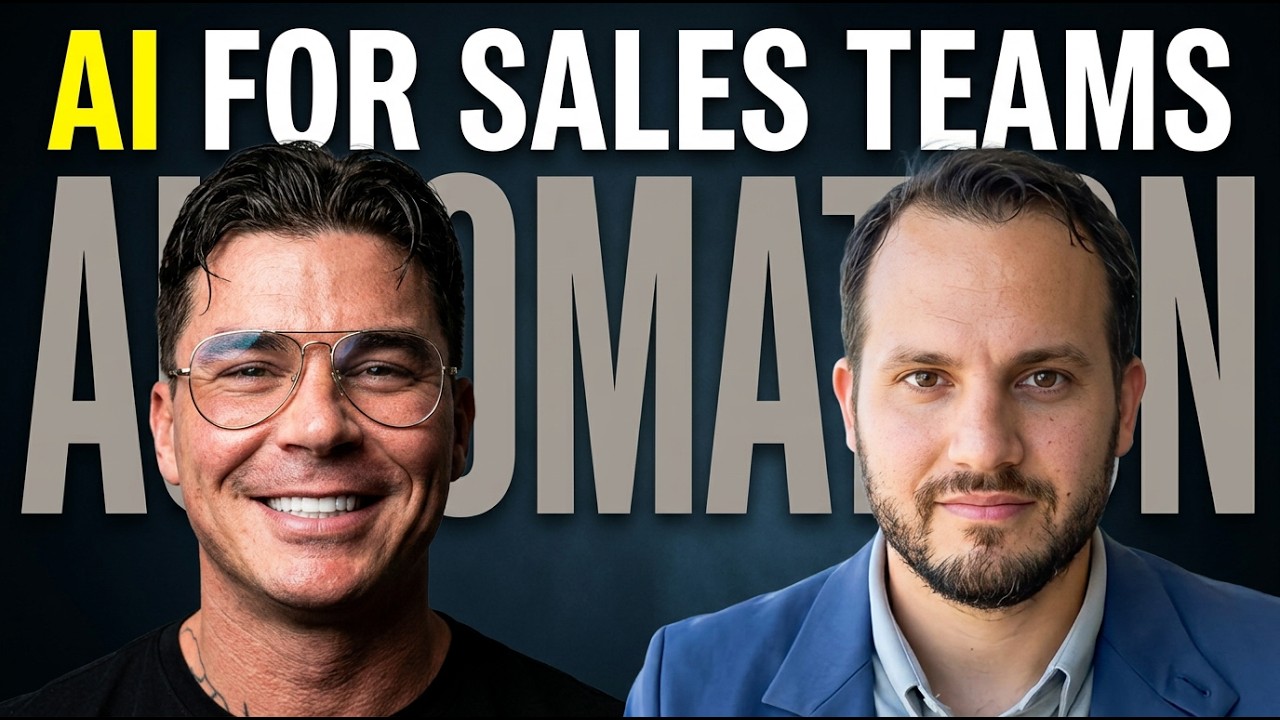
Full transcript of the conversation, published verbatim. Speaker labels come from the recording itself, not from an automated guess.
Jordan Lally:0:00
Welcome back to the High Ticket AI Systems Podcast. Everyone, please welcome the one and only Mr. Nathan Freysatter. Nathan, welcome to the show. How are you doing today, my friend?
Nathan Freystaetter:0:09
Jordan, great to meet you, great chatting with you here today. Thanks for inviting me.
Jordan Lally:0:13
Of course. Now we're happy to have you on. Now, one of the reasons we invited you is because for one, what you're doing, I think, in the software space is exactly what we need. No, I'll go ahead and let you explain, kind of at a very high level what the company does and who it best serves, and then from there we'll continue the conversation.
Nathan Freystaetter:0:34
Mm-hmm. Yeah, absolutely. So I'm the founder of GoFig. GoFig is a product that wires up.
Different software systems to create both data intelligence but also an administrative agent that you can wire up to AI for agent skills and orchestration. So what we do in a nutshell is we we are currently serving sales teams and accounting teams to streamline a lot of the administrative tasks to you know to take take off that administrative burden around those jobs. So if you think about a typical salesperson, especially in a B2B outbound function, the most important thing that that person can do is foster and nurture a relationship with a potential client, right? The prospect or the lead.
In order to do that, you need to know where they are in the buying cycle. You need to know what information they need from you, what questions they have for you. There's meetings you schedule with them. There's tasks and follow-ups that happen all the time. And you do this across dozens of clients.
Generally, a lot of people find that things are falling through the cracks, the CRM is not getting updated, and and with that, like there isn't an ability to look at performance and sales leadership can't do coaching. And so there's there's a whole a whole burden around how do we get the salespeople who are paid very, very well to keep doing the thing that they're really good at and the thing that actually drives the value of the business, which is meeting with.
Nathan Freystaetter:2:11
their potential clients without without the drag of doing all the administrative tasks, right? And so that's that's what GoFig and FigClaw do in our platform.
Jordan Lally:2:24
I was in Cole Gordon's STA, which is sales team accelerator program, and he barked on this idea of salespeople should do the activity they are hired to do, and that's salesmanship. Okay. Do not bog them down in admin work and you know, playing with the CRM. Like they are salespeople. Get an admin assistant or a I don't want to say a CRO, but somebody where their only freaking job.
Nathan Freystaetter:2:50
Yes.
Jordan Lally:2:53
is to work the data, make sure the CRM is up to date, and let the salespeople focus on selling. With with and it's so funny because like as as a founder, as you know, you you basically you're until you hire help, you're a one-man band where you are the salespeople, you are the freaking admin assistant, you are the CRO. And I think that actually gives great insight to building the best software
Nathan Freystaetter:2:59
That's right.
Nathan Freystaetter:3:08
Yeah.
Jordan Lally:3:20
To assist salespeople. Because unless you unless you're in the day to day, unless you're in the know, how the hell are you gonna build the top notch software to assist salespeople so they can spend less time in admin work and more time driving new business revenue? Right. So with that being said, my friend, can you take us back before you actually launch this software? Like how did life look, previous roles, and like what was the idea that that spawned this, if that makes sense?
Nathan Freystaetter:3:21
Mm-hmm.
Nathan Freystaetter:3:47
Mm-hmm. Yeah, so so we started with our our accounting finance reporting product, right? So we were we were not even in the sales world. We were we were just trying to sell to accountants and finance teams. And and what our product had done is all the administrative tasks around doing accounting and finance, we integrated with QuickBooks and Netsuites and spreadsheets where these these the teams tend to operate out of. And building the systems to automate the month end closed process. automate a lot of the accounting function in terms of you know daily and weekly categorization of accounts and transactions and and making sure everything aligned with the business rules, accounting rules for that organization, right? And you know reconciliation and other things as well, all part of that package.
In order to do this as a one man team, as well, we're we're actually a three-person company right now, but I but I'm primarily the the sole salesperson, is that I had way too much of my plight, right? I'm building the product. we talked earlier about you know, part of being a founder is building the plane while you're flying it, right? So I'm building the product and trying to sell it at the same time. And so I knew that I needed a system. there are so many like great sales and go-to-market tools that exist. on the marketplace. and I'm using like most of them, right?
Nathan Freystaetter:5:16
I have clay for enrichment. I have ATO as my CRM. I'm using smart leads for my outbound. I have happenstance for for warm LinkedIn connections. and there's there's more that I can name. But but the problem that I saw with these systems that things were not really wired up, right? They they didn't really talk well with each other. And so even though like all these tools are very powerful and and did very specialized things, it still took a time out of my day to go through the process of can getting data out from one system into the next system so that we you can you can you know do the whole loop of finding a potential lead to actually doing the outreach and and to work with that lead, nurture that lead over through the sales cycle. as I've done that, we built a tool internally to do the connections for ourselves effectively. So I had my developer and I kind of collaborated on this together. We built this as an internal tool called FigClaw.
And FigLaw did all the integrations, is it worked similar to OpenClaw, right? So it has all of the integrations, it has knowledge base, it has the database access, and it also has the skills of you know if this then that with some additional large language model processing of you know how do we route a certain input and so on. and after we built this, first of all, it was doing great for our internal sales, right? I I was able to do a whole lot more volume in terms of lead volume than I was before building the system.
Nathan Freystaetter:6:50
But then after I built the system, I was talking to a friend of mine who is a sales leader at an engineering services company, where he's traveling all around the world to do these big multi million dollar deals with AI data centers. And his clients are like all the big tech giants that you can probably name. and for him, like he's spending half of his time inside the Hubspot. He's spending half of his time on like the he has like an Excel calculator to scope the the cost of the deal to create.
RFP and it's like this whole this is a whole process, right? And and for him, like that doesn't drive the value. The value is in traveling to a client. He's in India right now, face to face with his client at their data center, right? That is his value. And so he's like, bro, I need this. I need this for myself.
And so he became our first client of of actually selling our internal tool to them.
Jordan Lally:7:52
I feel like whenever you build it for yourself, you it's like, okay, I have a problem that I that I face internally into my business. Now that AI is here, thank my Jesus. It's like, okay, with AI, how can I solve our internal challenge? And then you realize this is actually a pretty damn good product. It's making my life a lot easier. If I'm going through this challenge, I bet your ass somebody else is going through this challenge too. Let me see if I can actually sell this and go to market with it, right? Now
Nathan Freystaetter:8:03
You can't.
Jordan Lally:8:20
For those of us that aren't familiar with OpenClaw, right? What the hell is OpenClaw? And because I've watched some videos about it. I'm obviously not the expert, but I know it's pretty badass with the functionalities that you can do. So high-level overview, what is open claw and how did that spawn fit claw?
Nathan Freystaetter:8:23
Mm-hmm. Okay.
Nathan Freystaetter:8:37
Yeah, so so I I I I like to metamorphosize this a little bit. So think of if you were to hire an administrative assistant, right? A human person who comes in and does tasks for you, what information do they need to do the job? The first thing they need is a knowledge base, right? So so open claw. has all of the the same things that you would have in a person's job, but built in the system. So the first the first step is a knowledge base, right? Well, what is knowledge base? Knowledge base is all your policies and procedures, is all your accesses to your tools and your in your sales deck, like your CRM, and it has access to the database itself. So it knows who are your active clients, what stage they're in, blah, blah, blah, right? That's all there.
Okay, the second thing it needs is it needs a a heartbeat, right? It knows it needs to know when to act, right? Similar to like a an admin, right? You you tell your admin what you need to do is every time I have a meeting, I want you to take action items from the meeting transcript and put that into my hub spot and tell me when I need to do what, right? That's what an admin might do. in an open claw, you are setting up a trigger so that you have a connection point to let's say like your Google Calendar or your Fathom Note taker app.
So that when a meeting is happens, after that meeting completes, it sends a ping, like a message to OpenClaw to tell it this is done, and this is the first trigger for the actions that you need to take. Right? So that's like that's a heartbeat. It's it's a pulse that checks for updates every five seconds to see what's happening. All right, so you have things like your brain and you have a heartbeat. Okay, next thing you need to know is like the actual
Nathan Freystaetter:10:34
Jobs that need to be done, right? If this, then that. if a call is complete and you get a transcript, you need to put in the action items into HubSpot tasks and put it on your calendar to set meaning reminders, right? Okay, that's effectively a skill, right? It is a skill in the terminology of Claude. It is a skill that sets a list of rules that is fed into a prompt into any large language model conversation and any session that will then run that skill with the context of the knowledge base right so it knows okay I need to create this in HubSpot and again it has accesses to HubSpot okay so when you combine these three things together you what you have is is a very powerful if this then that system right So when anything happens, you know, is this especially great for any of these like recurrent workflows like CRM hygiene, right? Anytime you have a meeting that comes in, you don't have to think about it. You don't it and it and it's like having a dedicated administrative assistant that's working for you that you custom build to meet your needs. That is that is open call.
Jordan Lally:12:00
Thank you for the context on that. With FigClaw, rumors have been spread that open claw is not the most secure and it's been hacked a bunch of times. How does fig claw compare with open claw from a security standpoint and data protection standpoint?
Nathan Freystaetter:12:18
Mm-hmm. Yeah, so security is the biggest concern, especially when you go into enterprise, right? So for for us, because we're selling largely to B2B outbound teams that that are doing bigger sales in enterprise companies, that security is important. And so and actually the first client that that we landed This particular salesperson was using OpenClaw personally for his own personal tasks, but not in this company because of that concern around security. And so what we built with FigClaw is our entire system that has that brain, that heartbeat, and that set of skills, all in a custom, you know, cloud-based app inside their own servers. And so the problem with OpenClaw is.
It's connected to its own set of systems, and you don't know when AI decides to send your data out to those external systems. And because it's open source, anybody can make a code change to that code base and push it, and then effectively steal data out of if you if you're using open call.
So for FigClaw, it's closed source, right? We build it, we maintain it, and we customize it, and it's fully deployed on premises on a client's own cloud, for example, cloud Azure an Azure Cloud, Google Cloud or AWS Cloud. It's fully implemented in their systems, and it's only accessible by their team to access through their VPN, right? That way all their data stays inside their systems and inside their cloud server. Nothing can leave.
These these are the same clients that are using an enterprise tier of like anthropic or or open AI to power those systems. But you still always need some large language model to power this whole system. And that's where that's where enterprise is at the same level security.
Jordan Lally:14:17
Can you describe like a dream client or I guess a company that is absolutely suited for FICLA?
Nathan Freystaetter:14:24
right now we're we're doing great with BDB outbound. So so and that's largely IT MSPs or or like software shops. these are companies that have multiple clients that they're doing work for. And it's so it's so heavily dependent on that relational aspect.
Jordan Lally:14:35
Got you. Understood.
Jordan Lally:14:45
Absolutely. Yeah, I think the more enterprise the the more up the ladder you go when you start laying the enterprise deals, you know, 12 month, 24 month contracts, six figures, multiple six figures, it's it's really about relationship selling, not transactional at all. And as I I as a as a young man coming up in the enterprise world, I have realized I come from a hardcore transactional background.
Nathan Freystaetter:15:05
Yeah.
Jordan Lally:15:14
Like banging on somebody's door and selling solar that same day. Right. That is not how enterprise sales works at all.
Nathan Freystaetter:15:21
Well well well because like if you're selling like a knife, you know, it's fine. That's fine. Like you never see that guy again. But enterprise sales, you're selling like a multi-year relationship. You know, it's almost like the contract's almost like a marriage, like, yeah, you're gonna have to deal with me and my team for the next you know, as long as we use this product.
And that's why that's why especially like especially when it comes to like software servicing or IT MSPs, like if you need help, you have to talk to this person. He's effectively your account manager. You gotta like that guy. Because if you don't like him, you're not doing business with them.
Jordan Lally:15:41
Exactly.
Jordan Lally:15:53
Exactly No exactly, exactly. And on that note, what have been some strategies that the company has used internally to start networking and actually building relationships? I feel like this will not only help me for selfish reasons, but definitely help the audience who is selling B2B Enterprise.
Nathan Freystaetter:16:09
Yeah. Yeah.
Yeah, I mean it's all in person. It's all all in person.
Right. I and you know, I I don't think you can build that relationship by sending out a cold DM on LinkedIn or a cold email or even a cold phone call. I mean, you can and I and I think that's like where the systems come in because there's so many tools out there today where you can find that warm relationship with someone that you don't know, right? A second degree connection on on LinkedIn, for example, where you can build a hyper custom message.
To get them to take interest in wanting to meet with you. Right. And I think even then it gets so far, only so far, really I found the best to be able to go to in-person networking events, tech events, in your local cities and build your brand, brand presence there, especially if you're starting out.
Get people to know you. Make sure that you're building a relationship or presenting yourself, that you are someone that they would want to work with.
Nathan Freystaetter:17:20
and if you're starting out especially, like do some work for free, right? Show them that they're not going to be making a fool of themselves by by spending a lot of money on someone who can't actually do the job, right? If you have no credibility yet. do the work and get the get get those case studies, get those testimonials, and because a lot of these high-ticket sales are going to come from is someone else telling someone else, I used this company, and they did great. and and having a referral back to you.
Jordan Lally:17:53
We actually were talking about this exact topic a bit off camera, where if it is a newer product with no proof backing, no case studies, no testimonials, if you can be transparent with your prospect and let them know exactly that. This is a a brand new product that we're launching. It's gonna be a little finicky. It's not perfect by any means. We're either gonna two options, right? Depending on cash flow. We'll do it for free.
Nathan Freystaetter:18:18
Yes.
Jordan Lally:18:19
In exchange for a case study and feedback, which is way more valuable than money when you're first starting, or we'll do it like 75% off, right? Because like we need casual to like survive. and as a thank you again, you get 75% off and a case study and feedback, right? And you were saying off camera here that by you being transparent and just letting your prospects know, sales has actually gotten easier. Like you're not trying to sell the golden yacht.
I in this example, like you're selling a a makeshift broken yacht.
Nathan Freystaetter:18:49
Yeah.
Yeah and and and and Especially for me, this might not be for you, Jordan, but but for me, I I felt that I I was uncomfortable selling something for the full price when I knew that it wasn't perfectly polished up. I'm and that's because I'm a bit of a perfectionist, right? Like I didn't want to go out there and say, This is a hundred twenty grand, you know, we're still building it. You know, we're still flying the plane. by coming in and saying, I want to find a partner, I'm looking for a partner to that can help me build this out. It's it's It's already shaped out and we're using it internally. Like I know it's going to add value. I want to build it for you to free, and I know I can add value to you. That takes all the pressure off of me to make that pitch. Whereas if I if I desperately needed that money and I wanted to sell it for the full price without that case studying testimonial first.
I would not have enough conviction to to convince the person on the other side that they should pay for it. Now, now after I have those five, 10 case studies, then it's like, you know, I'm I I am on the yacht, right? I am on the yacht. I know, I know that we can do it. We have all the, you know, you know, putting back into proof. and that's a different story.
Jordan Lally:19:58
In conviction.
Jordan Lally:20:04
Yeah.
Jordan Lally:20:14
No, absolutely. And as a salesperson, I learned this very, very, very young, late 1819, is confidence and conviction. That's really all you need to actually make sales. And if you don't believe in what you're selling because it's not polished yet, that will slip through your tonality. If they ask you a question and you're not fully confident and have full conviction, it's gonna slip through, bro. And Jeremy, Jeremy Minor, don't know if you know who that is in the sales world, but like tonality is I don't know, like twenty-five percent body language is more and your actual words are like three or seven percent, whatever the hell their ac the actual statistics are. The point is, is that body language and tonality hold a much larger value on communication than the actual words that you're saying. So getting back to your point, if you're not fully confident and have full conviction in a hundred and twenty K product, you're not selling it at a hundred and twenty K, you know?
Nathan Freystaetter:21:12
Yeah. Or at all. Not at all.
Jordan Lally:21:13
Exactly. Getting getting back to the significance of Fake Claw. I I watched this gentleman on YouTube. He sells extremely large high-ticket products and services. he charges 15k per month for marketing services plus a 10% profit share. And after helping a lot of companies scale to like over a million dollars plus per month, what he learned. from a CRO standpoint, is contextual follow-up and contextual marketing messages. And the way he breaks it down like this is I love it. I'm not sure if you ever shopped at Louis V like Louis Vuitton. Like, I'm not gonna lie, like I don't, but he does. Okay. So his stories are I can text my personal congierge saying, Hey, I'm gonna go to the Louis V store tomorrow at seven o'clock, like PM or whatever. And and like I Like I'm letting you know I'm pulling up. So whenever he gets there, not only does he get escorted there, but nobody else is in the store. It's only him, his personal congiers, and his bodyguard, like the bodyguard in front of Louis V in front. The point of the story is the personal touch. He's probably dropping like 50k, 100k every time he goes to Louis V, like him, like him and his girl or whatever, right? So when we think about that in our B2B sales.
Contextual and good contextual marketing meaning personalized messaging. If you notice that somebody viewed this specific post or liked this specific post and left this specific comment, you can use that in your marketing message. Or if you have a pixel on your website and you know that this lead checked out this specific case study or they spent most of the time on this specific section in the website, you can use that in your marketing material.
And the list goes on and on and on. Let's pretend that you set a follow-up schedule, like I just did the other day, a follow-up schedule on the calendar, and their sure objection or or what they wanted to process deeper was X. Now I can send them three or four emails about X topic to help them come to that decision quicker. You see? And that personalized touch is how you get big boy deals done. Thoughts on that?
Nathan Freystaetter:23:18
Yeah.
Nathan Freystaetter:23:29
Yes, I love I absolutely love that. I love to love it.
Honestly, honestly, this is where this is where AI is like super powered, right? Because if you are collecting every single data point on who's visiting your website, what message comment they're leaving on your LinkedIn posts, and you're scraping your LinkedIn posts, you build the centralized database with all of these data points, you can do lead scoring, you can you can have AI build follow-up messages based on that context and set that sequence up and you don't even have to think about it, right? You can do this, you can scale the volume to do this like a hundred Emails a day, right? Think about that. One person, one salesperson doing a hundred follow-up messages per day based on all this activity that's happening on your LinkedIn, on your on your and on your website.
Jordan Lally:24:15
You know, with Outbound, because when I first started my agency seven-ish years ago, I landed my first clients for my advertising meta ad agency through cold email. And back then you could spray and pray and all was well. Cold email was the best. Nowadays it's a bit different. Google is very sophisticated, they're using AI to catch cold emailers, same thing with Microsoft.
So we actually had to take a massive step back from the spray and fray model and do exactly what you did. A very detailed, targeted list, so much personalization behind that. Personalized, not as if AI wrote it or the only the first line is personalized. But whenever they read that message, it's like, how in the world do they actually know that? And because it's so specific to them, it's like, I'm definitely replying to this email. No, I'm definitely gonna book this meeting. They took the additional time. to to personalize this, right? so feedback and thoughts on that being a a B to B outbound guy.
Nathan Freystaetter:25:22
Yeah, I I mean I I love it, right? It's it's everything that we're saying and and it's about again when you talk about high ticket sales, right? We're not selling we're not selling a one time purchase product like a set of knives, a set of stick knives, right? This is a you know, this is a relationship you're selling. And so that you need to start with that relationship to get their attention to even want to work with you, right? It's not about it's not about, you know, making a claim that I can do X, Y, Z, because there's hundreds of people in my inbox every day making the same claim that they can do X, Y, and Z. Right.
So the way the way that I have it set up is I'm scraping my LinkedIn. every time I make a post, I get about 20 comments on those posts. And I'm scrapping the LinkedIn to find all those profiles, the names of those profiles, and the comments that they made on and the post that they made it on. and I put that into my database. I enrich those leads with clay CRM. I have their phone number and I have their email. And that goes into my CRM.
So now I can start collecting other activities that that same person might do in the future to build a lead scoring model. Right. And once I hit a certain trigger, certain threshold, that's when I start my sequence to do the follow-up emails that are hyper-contextualized. And that's that's a whole different game point because like now it's not this is not a cool email anymore. Even it's the even if it's the first email I send out, there's been some conversation already happening. It's it's semi-warm.
Jordan Lally:26:51
Absolutely. And how has that like how are those results been if if you're open to sharing feedback on that? How has the receptive receptiveness from the leads from that process?
Nathan Freystaetter:27:04
It's been about a twenty percent response rate on those on those emails. Yeah.
Jordan Lally:27:07
That's amazing. Compared to traditional cold email where you're lucky if you get like one point five or one point two percent reply rate, you're twenty X you're twenty X in that. That's freaking
Nathan Freystaetter:27:15
Right. Yeah. Twenty percent.
Yeah. Yeah. Yeah. And most of that don't have to think about it. Right. Most of that.
Jordan Lally:27:24
It gets all automated with and I I presume FigClaw is the is the is the is built on this. Or like that process is built on the back of FigClaw.
Nathan Freystaetter:27:33
All those integrations that I talked about, like my webs, my my LinkedIn scraper and the Clay CRM, all those are connected to my our own FigClaw deployment. So they're all wired up. We have our custom skills and workflows that are created that take those those steps. Right. And so all I see is when I log in onto our command center portal on FigClaw, is a set of cards of like here's a queued up task that Fibclaw recommended based on all those rules. And I can simply hit approve. or edit and then approve, then it'll go ahead and send out those emails. And so instead of like typing out those emails, I see all the context and and the draft and I can I can just click approve, approve, approve, approve, approve, boom, 20 emails sent.
Jordan Lally:28:18
That's so that's so cool, man. So it literally does everything from A to Z to you or A A to Z for you. Question on the onboarding process, right? Let's pretend that I work in the IT space. I absolutely love what I'm hearing. From contract being signed to full implementation, how long ballpark is is that process?
Nathan Freystaetter:28:38
it takes about four weeks right now. the first two weeks are or the most of the most of the time comes in from the IT provisioning to work with the IT team to do the custom deployment inside of their cloud servers.
At the same time in parallel, we'll get requirements meeting with the sales team of what their process looks like. And we'll build all the integrations and build the custom skills for them. So that by the end of the three the first three weeks, they can start testing it on that fourth week. And that fourth week is is remained to do you know testing and collaborating and iterating together to make sure that it's fully pol polished up and ready for production at the end of the fourth week. So so it's a four week sprint and which which you know, for custom deployment is is quite fast for enterprise is very fast. and that's because most most of what we build is is you know reusable and it's it's just like a custom it's the custom skills that that we create, right?
Jordan Lally:29:26
Yes.
Jordan Lally:29:37
And that's the best thing about niching down that I would just love to slap everyone who hasn't niched down yet. But like, love you fans. Anyways, when you only work with IT companies or MSP companies, you they have the same problems. Like nine times out of ten, this IT company has the exact same problems as this other IT company, right? So when you only work in this industry, your onboarding your onboarding process is significantly faster than another software company. The sales process is semi-repeatable because it's the same problem and you solve it the same exact way. Now you're actually building an enterprise company, brother, and I'm freaking happy for you. You know, like fuck yeah, dude, that's awesome.
Nathan Freystaetter:30:21
No, it's easier said than done, right? Like initially, I didn't know who what who the ICP was. I didn't know who would buy it the most. And and and I'm I'm curious how how you would recommend your your viewers here to find the ICP because it it took me a long time. It it I I went through a lot of different corners to find IT MSPs and software shops.
Jordan Lally:30:43
If you're just starting out with absolutely like no business as an example, I learned this from Cole Gordon, but it's like the three, the three circles, they all overlap. That's your ICP. Okay. So what do you what are you good at? Right? Like, what are you semi-good at? Okay. Now that you're you you know what you're good at, like what do you know? Like, what do you actually find that like you can speak on intelligently? You can actually have a a very good back and forth conversation. And then lastly, what interests you? So what are you good at?
What can you actually speak on? And what are you open to learning more of? If you can combine all of the all of these three things, that's the business that you start. That's going to be your ICP. Now let's pretend that the business you start isn't in this category and we're just focusing on ICP. I would really lean into this one here and what what can you solve for? Not necessarily what interests you. I mean, maybe maybe for longevity purposes, that might be a good idea, but what can you speak about?
Like w what are you actually knowledgeable on in this one? Does your product or service solve a problem that you can actually speak about? I probably butchered that, but that kind of makes sense at all.
Nathan Freystaetter:31:52
Yeah, yeah, I like that. I like that. I I think I think I I I I think my path was actually pretty similar, right? So if if I if I went through that framework there, the thing that I was passionate about is systems. the thing that I could speak about is finance and data science, because that's that was my career path up until the point that I started the company. and the last one that I was interested in,
Jordan Lally:31:56
What your what was your path, if you don't mind me?
Nathan Freystaetter:32:20
sorry, I actually that was the first one. What was what was the the third one?
Jordan Lally:32:25
like what what what you're good at. What you're good at, what you can speak about or what you can speak on, and then some of that interests you that you're open to pursuing more of.
Nathan Freystaetter:32:28
What I'm good at. Yeah.
Nathan Freystaetter:32:34
Yeah. Yeah, I'd say I'd say I was good on both both aspects of of the systems around around finance and and analytics. And so that's where I started. But I but I found that I was really hitting the pavement for accounting and finance teams. And they didn't you know it was really hard to sell the systems. It was not like a natural, yeah, I need that or I wanna pay for that. and so took took about a year, and really it was that process that I shared earlier about how I kind of found myself talking to a friend in sales where I was like, they need the systems. We can build the systems for them. and then when I then I then I started the process of doing pilots with my network, because I've done a lot of networking in my local local city and my local economy, and found found the companies that wanted to be a pilot, right? They wanted to be a guinea pig for my system. And then from there it's it's like, okay, now I know who actually wants this and who's willing to pay for this.
Jordan Lally:33:38
That's so interesting how you bring that up because maybe other people are not like me, but I really want to say that majority of them are like me. A business owner, when when they're thinking about investing into a new service or a new software, a new plan, I think nine times out of ten, if it's gonna make them more money, like sales systems or hiring new salespeople or a new marketing campaign, I think they're gonna invest in that shit all day long. It's like, like.
Nathan Freystaetter:34:06
Yeah.
Jordan Lally:34:07
help out my HR department. Like I love my HR department, but it's not making me more money. You know you know what I mean? So so I'm glad you found that path because as you know quickly it it's working out.
Nathan Freystaetter:34:12
Yeah. Yeah.
Nathan Freystaetter:34:17
Yeah. I do. And it look, this is like business 101. Everyone says this when you're starting out, like you want to find the aspirin, not the vitamin. You know, and I heard that. I heard that. But but it's still like I don't know, so I feel like you just have to go on the the the journey of of being a founder and making your own mistakes and biving and and being able to pivot.
Jordan Lally:34:26
Mm.
Nathan Freystaetter:34:42
And and you'll you'll you'll find where you end up going is is you know where you need be.
Jordan Lally:34:47
It's so interesting because us humans love to learn. Well, especially me. love to learn from our own mistakes opposed to listening to all of the infinite knowledge we have on YouTube or the freaking books that we read, you know. It's like, that's a good idea. Let me implement. And then what do I do? Not implement it. And I do my own shit. It's like, maybe I should have listened to the book I read or should have listened to the to the video that I watched. But like you said, bro, and not to get philosophical, it's really about the journey, man. It
Nathan Freystaetter:35:15
Gosh, yes, it is.
Jordan Lally:35:16
Like 'cause you're gonna look back, I'm sure you can I I can, I'm sure you can as well, but it's like you look back and it's like, damn, I've grown so much. Like mentally, sales ability, skills ability, fulfillment. Like j I've grown as a person and as a business. It's like, fuck yeah, dude. Like I'm so happy.
Nathan Freystaetter:35:31
Yeah. Yeah, yeah. It it it makes you so well-rounded, right? Like I like, you know, i I I used to work in Fortune 500, corporate America, and and not to knock on them, I learned a lot working at the companies that I worked at. But you are a cog in the machine and like by design, and that's not a bad thing, right?
I want my company to grow big enough where I'm I'm also building a machine and people would effectively colleagues at that point too. But but you don't you don't just learn as much and doesn't feel as fulfilling and and you kind of get really good at one thing in a limited scope, but there's so much more to the human experience that you that you you just like if you if you don't work on those those well-runner components, those components are to atrophy. and and for I I think there's a lot of people out there that are are like totally content with that and they're fine and they have lots of things outside of work that fulfill them. I was not one of those people. Like I needed, I needed to feel challenged on like all of it, the whole experience. and gosh, this path is so hard. Being a founder is so, so hard. But I but I would not choose a different way.
Jordan Lally:36:42
Wouldn't trade it for the world, bro. Are you kidding me? Absolutely. No, I feel the exact same way. Getting getting back to the people who
Nathan Freystaetter:36:44
Yeah.
Nathan Freystaetter:36:48
Gosh. I feel like we need a beer. We need to catch up in person and hang out sometime. We can we can talk all day.
Jordan Lally:36:53
I I'm in Salt Lake City, Utah, man, but I'm down to fly out and travel. It's very curry out here.
Nathan Freystaetter:36:57
I love Utah. I love Utah. I went to s I went to school in Utah. Did you know that? I went to Brigham Young in Provo.
Jordan Lally:37:02
I did. Where'd you go?
Yo BY the U. That's amazing, man. Not not the U. BYU. My mistake. My mistake. My mistake. Yeah. It's super pretty up there, bro. Prolot's amazing area. but nonetheless, I want to say this one thing, and then we'll talk about goals in the future, and then we'll definitely we'll definitely grab a beer in part ways here. But we need people like my brother that is just so content, bro. Like working their nine to five.
Nathan Freystaetter:37:10
Why? Yeah, yeah. Not the yoke.
Jordan Lally:37:32
Doing the task that they have to do and have zero aspiration to move up in the company, like become an entrepreneur. We need people like that, dude. But people like us that I think just have a bigger appetite for risk, that's essentially why the entrepreneurs of the world make more money because they're simply willing to just take on more risk. Right. And it's it it is a big leap of faith. And I would love to talk about your journey really quick, about like what were the months leading up?
To jump in off the cliff, what was your internal dialogue, your thought process when you actually did and how were the first few months afterwards? Because like from going to corporate America where it's comfortable, you're making pretty good change, you know, like the American dream, right? House, pick a fence, you know, Mary, like, like, like the dream. It's like, but I want more. I know there's more out here of the human experience. So I'll stop there. I love you having the floor. How was that process like?
Nathan Freystaetter:38:30
It's been a 15-year journey, Jordan. And if if you want the full story, it's gonna be more than you know, but but but if I if I can boil it down to the short version here. 2008 happened when I was still in high school and my dad was a realtor. And I was I was grew I grew up in South Florida, and flat South Florida got hit hard by the 2008 crisis.
I was working a job making like five bucks an hour at that time. And and I knew that like I needed to actually make real money. and so I started an an e-commerce business. I started up an eBay account and I started making my own products. and so that was my like my first company ever, and it was it was like in a in a it was I was making little miniature figures on a board game that I love to play called Hero Scape and I made my own custom figurines and I sold them. And like I found collectors that were bidding up hundred dollars on these like little little games, pieces that I was making. I couldn't believe it, right?
15-year-old kid who's making five dollars an hour, like that was like, my gosh, I can create something and make like that I that I care about and passionate about and love doing, and I can make a hundred bucks an hour doing it, like amazing, right? Amazing. And so I got caught on this bug. I ended up going through college and and the career route for you know, feeling the sense of like I needed this the secure path. I feel like I didn't really have any safety nets around me.
And so I needed to build that safety net for myself. Ended up getting married, having kids young. you know, we have three kids now. and it wasn't until last year that we had, you know, our kids were old enough or my wife could go back to work and and for me to to build enough of a of a safety cushion for myself where I could take this risk. Right. So it was very much planned over the last 15 years. but it's it's kind of been agonizing of like, I need to do something because I'm not fulfilled. and it's been it's been that feeling for like 10 years. Like I don't understand the people around me because everyone seems to be happy and I'm not happy. Like what's wrong?
Nathan Freystaetter:40:28
with me. and I I got leading up the the year before I left corporate America and I was working at Square Financial at the time.
Jordan Lally:40:39
Yeah.
Nathan Freystaetter:40:40
I got involved with my local entrepreneurship ecosystem. and I met with other founders, early stage, late stage founders, talked to investors, I talked to people who are just in the ecosystem. And every city has one. I would highly encourage you to go there to to anyone starting out to get start there, right? Just to just to be exposed and to see what that life is like. And and I just found like my people right away. Like these are the people who I can relate with, right? These are the people that are like me. you they're not satisfied with the corporate comfortable job and and and they want they want to go through this like this process and that's that's how like there was that confirmation of like this is this is it this is what I need to do and once all my ducks were were in order Started my company, started building the product, started networking, again, my first first few trial pilot customers. And once I got my first client, I put in my two weeks notice.
Jordan Lally:41:43
Was your first client enough to was it equal pay of what you were making? Was it a a subsidy in pay or like sub or was it more in pay? Your client or just salary?
Nathan Freystaetter:41:54
It was about five percent. It was about five percent of what I was making.
Jordan Lally:41:57
Holy shit, dude. And you said fuck it, I'm quick. That's dude, no cojones on you. That's awesome. I mean, because you have like a you have more responsibility. Like I'm a single guy with no kids. Like you have a family. Like wife, three kids, you know, like you have way more responsibility. And to take a huge 95% pay cut, like fucking cojones on you are massive, dude. Congratulations. That's awesome.
Nathan Freystaetter:41:58
No.
Nathan Freystaetter:42:23
Wo I wouldn't trade it for the world, man. Wouldn't trade it for the world. It's not easy. It's not easy, but but I wouldn't trade it for the world.
Jordan Lally:42:25
All right.
Jordan Lally:42:30
No rewarding. As we are wrapping up on time, over the next twelve months, I know you have two products. we'll we we can talk about big claw, but what is one thing that you're helping the company accomplish looking back over the next twelve?
Nathan Freystaetter:42:48
I'm really excited about building a team up. I we currently are a team of three. we're hiring a fourth person right now. I would love to get to a team of 10 and be doing $3 million in annual revenue by the end of that 12 months. And what that would allow us to do is is to have an average revenue per employee of around 300,000.
Right, so so I want to get to the point where I can pay my team comfortably, but also be positioned to scale this. Because after the 12 months, I want to, you know, continue, continue to scale that and continue to scale that within that team size. Right, because once you hit you know, the the three-year plan is over a million dollars per revenue per employee.
Jordan Lally:43:37
I like that. I like that. Where can they find you if they wanted to explore fake claw, my man?
Nathan Freystaetter:43:44
They can find me at on LinkedIn, Nathan Freistadder, or they can and I would start there, send me a message, love to connect, love to have a conversation. you can email me at Nathan at GoFig.ai, or also check out our website at gofig.ai
Jordan Lally:44:03
Amazing. Nathan, I had a fucking blast having this conversation with you, bro. We'll definitely have to catch a beer or grab a beer in person. But just thanks for joining us. Absolutely.
Nathan Freystaetter:44:12
I love it. Thank you so much, Jordan. Great to chat with today.